Blog
-
Welcome to the web archive of the ME/CFS Medical Education Campaign
The campaign is no longer active. We’re leaving the website up as an archive, but please be aware that some of the information may not be current.
Some other sources of information on ME/CFS medical education in the UK:
-
‘Life with a low battery’: a wonderful short cartoon explains ME/CFS in a relatable way
‘Life with a low battery’ is a 6-minute video which is perfect for introducing ME/CFS to family and friends of someone living with the illness.
ME/CFS is a complex, multisystem, energy-limiting illness which is often misunderstood, leaving patients struggling to get the understanding and support they need. Now the experts at the Bateman-Horne Center have come up with a way to explain ME/CFS that we can all relate to, using the analogy of a phone with a broken battery that can’t hold much charge!
The video is available in several alternate versions for people with sensory difficulties: no music; muted colours, no music; and muted colours, no music, no motion. There’s also a transcript.
-
Discover M.E. – animated video for healthcare professionals
A new 6-minute animated video provides insight into the experiences of people living with ME/CFS. The video is part of the Discover ME Experience, a two-part (CPD accredited) educational 3D virtual reality or 2D short film, with accompanying information pack, available free to healthcare providers and medical students in Northern Ireland. For more information, contact the charity Hope 4 ME & Fibro Northern Ireland.
-
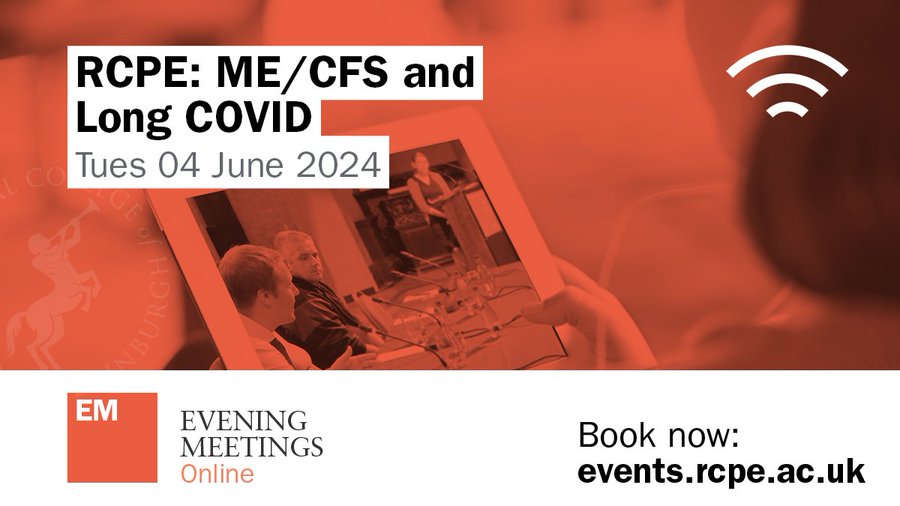
ME/CFS and Long Covid: online #MedEd event on 4 June
There’s just over a week left to sign up for the Royal College of Physicians of Edinburgh’s online event to improve understanding of infection-related chronic illness! The event is open to all grades of medical, health care and scientific staff, and to students.
From the event website: “During this webinar you will learn about the pathophysiology of ME/CFS and Long Covid, clinical presentation, making a diagnosis, and common associated conditions such as Postural Orthostatic Tachycardia Syndrome (POTS). You will also learn about up-to-date management strategies and treatments.”
- The cost is $20
- Participants receive 2 CPD credits
- The event has a Twitter/X hashtag: #rcpeMECFSLC
- 6.00pm – 8.30pm (BST)
-
Children with severe ME/CFS taken into custody
World-renowned paediatric ME/CFS specialist Dr Nigel Speight discusses a disturbing scenario: severely ill young people with ME/CFS and their families are persecuted by the healthcare professionals. This is a difficult video to watch, but it is incredibly important.
-
Malnutrition and ME/CFS: the NHS is still getting it wrong.
This article was updated 13 February 2024.
It’s happening again.
The young woman was so weak she could barely tap out a few words from her hospital bed, but she wanted to let the outside world know what was happening to her. The doctors had decided to take away her NG tube. They’d decided her problems were psychological and she “needed to try eating a little food”.
This young woman does not suffer from anorexia nervosa. She has ME, a serious neuro-immune condition which has left her profoundly ill. She desperately wants to eat but she is too ill to hold down food; all she can manage is to swallow a bit of water each day. Without the NG tube she will starve.
This happens every few months or so. Last year it was 25-year-old Alice Barrett; Barrett’s severe ME left her able to swallow only a small amount of liquid food each day, so she became malnourished and needed tube feeding. Her family did everything they could to convince the hospital to provide the life-saving treatment, but their arguments fell on deaf ears. Undeterred, the family set up a petition which received over 10,000 signatures. There was a social media campaign and articles in the local press. This story has a happy ending: the publicity worked, and Alice was given a life-saving NG tube. But families shouldn’t have to campaign for their loved ones to receive medical treatment.
(more…) -
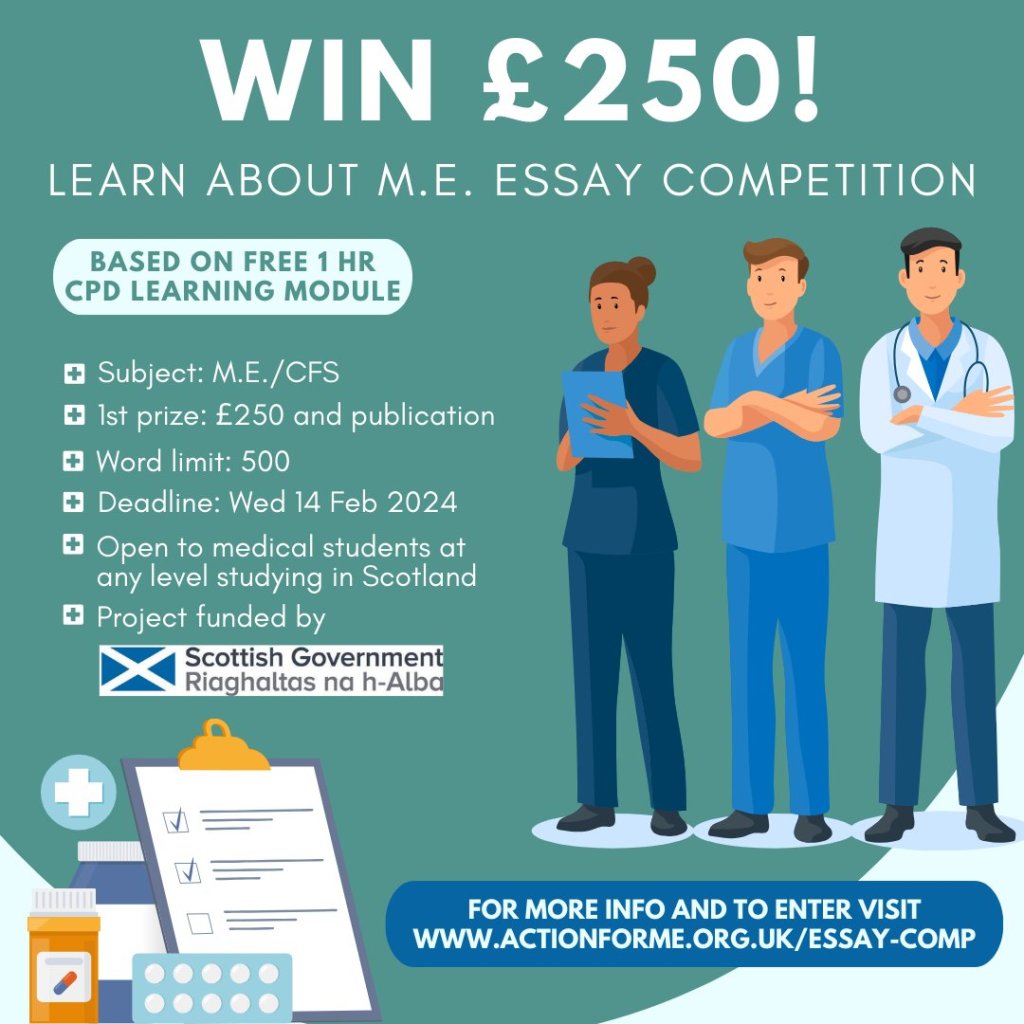
Learn About ME essay competition for medical students studying in Scotland
Medical students studying in Scotland are invited to take part in the Learn About ME essay competition! The winner will receive £250, and the winning essay may be published in The Journal of the Royal College of Physicians of Edinburgh. To enter, students must:
• Complete the free one-hour CPD course on ME/CFS by Dr. Nina Muirhead, available at https://www.studyprn.com/p/chronic-fatigue-syndrome.
• Write an essay on the theme: “What is your most important learning point about ME/CFS?” with a maximum length of 500 words.
Full details of the competition at Action for ME.
-
Might the NHS finally remove the harmful and outdated information on ME/CFS from its website?

NHS logo. The NHS website information page on ME/CFS has so many problems, it’s hard to know where to start. The overall picture it gives of the illness is trivialising – for instance it lists the main symptom as “extreme tiredness”, which is not an accurate reflection of this serious multisystem illness characterised by a profound lack of energy and intolerance to any and all forms of exertion. The phrase “you may find it very hard to do daily activities” does not do justice to a condition where 100% of sufferers are unable to keep up with the activities they did before they were ill, 75% are unable to work or attend school, and 25% are dependent on care. Even worse, cognitive behavioural therapy (CBT) is wrongly listed as a treatment, in direct contradiction to the NICE guidelines, giving the false impression that ME/CFS is a psychological illness.
The NHS website is trusted by both healthcare professionals and the wider public, so unfortunately these egregious mistakes have a big impact. I wrote to the NHS website team about this, and got this brief reply:
“Thank you for the feedback on the topic. We are hoping to review the content you are referring to within the next six weeks as the date of the next review has been bought forward. Kind Regards, The NHS Website Team”
(more…) -
A mother of a child with severe ME/CFS describes troubling experiences of medical harm and accusations of abuse in healthcare settings
Children with severe ME/CFS and their families all too often face misunderstanding and accusations of abuse in healthcare settings. There is little awareness of these experiences, in part because many families are understandably unwilling to share their stories. I’m very grateful to Tina Rodwell, who is a full-time carer for her son Angus, for sharing hers.
. I’d like to highlight several points in Tina’s story which sadly are not unique, but form a pattern which advocates see repeated over and over:
- The doctors involved had little knowledge of ME/CFS, or they had out-dated knowledge.
- When the MRI scan came back normal the consultant neurologist jumped to the conclusion that there was nothing physically wrong with Angus, and that his mother was somehow the problem.
- Once one doctor had decided that the illness was ‘not real’ and that the mother was untrustworthy, every subsequent doctor looked at Angus and Tina through this lens.
- Acting without Tina’s knowledge or permission, a clinician had Angus do strenuous physical exercise. This clinician was unaware that exercise can be dangerous for people with ME/CFS. The exercise prompted a very serious relapse.
- Because doctors did not recognise the seriousness of Angus’s illness, the school considered him to be ‘truant’ and a school attendance officer got involved. Tina was lucky that the attendance officer was familiar with ME/CFS; if not for this stroke of luck the family might have faced a referral to Social Services.
- Tina advocated for her child and protected him from harmful treatments. Because of this, doctors concluded that she was fabricating her son’s illness.
- Tina moved Angus to a different hospital, but the accusation of fabricated or induced illness (FII) followed them.
Tina has made it clear to me that she doesn’t want medical professionals to feel blamed or attacked by her story. She wants them to listen and understand, and find ways for clinicians and families to work together to provide better care for kids like Angus going forward.
-
The Royal College of Psychiatrists promotes dangerous ‘treatments’ for children with ME/CFS

The logo of the Royal College of Psychiatrists. Update 07/11/2023: the webpage has been taken down!
The Royal College of Psychiatrists, through their website, recommends that children with ME/CFS should receive graded exercise therapy (GET) and gradually increase their activity. Although the website claims “this is not advice,” in fact it very clearly is advice, and is likely to be taken as such by patients, their families, and by healthcare professionals.
GET is no longer recommended for people with ME/CFS because it can provoke post-exertional malaise (PEM), a form of relapse which can last for days, weeks or months, and in some cases can become permanent.
(more…)
 ME/CFS Medical Education Campaign